My Thoughts on Watching Predators

•May 21, 2006 • Comments Off on My Thoughts on Watching Predators

Sean does laundry on Sunday, so we generally stick close to home. I went over to the garage top early in the morning. While I didn’t get any pictures of Hercules and Max today, I did see something funny.

I didn’t see either bird when I arrived. Scanning the sky, I saw a gull fly into view, lazily cruising south. Out of nowhere, one of the falcons dove towards the gull.

I thought for sure that a grim end and the gull were about to meet, so I steeled myself, not sure how that would go. The falcon hit the gull, but just on the very end of the gull’s wing. This threw the gull off balance for a second, but it quickly righted itself and stubbornly continued south.

The falcon hit the gull’s wing tip maybe five or six more times as the gull traced its way south. Each time, the gull wobbled in flight, righted itself and then kept flying south. Finally, the falcon turned and flew north, leaving the gull to go about its day. Bored?

Mary told me a similar story a few days ago. She was watching a juvenile peregrine stretching his wings down by the Indiana Dunes. A big heron flew by and the peregrine did a similar thing, hitting the heron’s wing tip which made the heron flip and roll in the air before it righted itself again. Most animals play and Mary said this was probably a falcon’s version of play.

This is as good a time as any to mention the prey-predator relationship. Anyone who knows me knows that I am extraordinarily sensitive to animal death. Seriously, I can hardly even watch nature shows anymore.

How, then, can I sit here, day after day, and watch Hercules and Max hunt right in front of me? Well, sometimes it is hard. I think all birds (yes, including pigeons) are beautiful and interesting, so I of course feel a pang when I see that the falcons have killed one, especially if they do so right in front of me.

However, I’ve sort of surprised myself with this project. For one, Hercules and Max are highly efficient killing machines. I’ve hardly ever seen one of them come back with anything but a dead bird. The few times I’ve seen them with a half-alive bird, they’ve landed and dispatched it very, very quickly. So, it helps that they kill quickly so there is no suffering.

For two, unless I sprouted wings, I couldn’t do anything about it anyway. What am I going to do? Yell a warning to the other bird? And then, Hercules, Max and the chicks would slowly and brutally starve to death. Nature is tough to watch sometimes and honestly, if it were another type of predator, like maybe wolves, which kill quite a lot less swiftly sometimes, I probably wouldn’t sign on for the observation job.

Anyway, just my two cents.
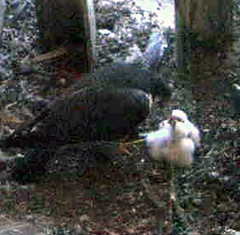
Evanston Webcam Capture 2After this odd gull harrying sequence, the falcon landed on the skyperch, puffed up and settled in for a nap. I packed up and headed on home. When I got there, I thought I’d turn the Evanston webcam on while I did some work on the computer.

Evanston is the first town on the northern border of Chicago’s city limits. This pair nests on the library. Although these pictures are grainy, it’s at least a picture of a nest area and babies. It’ll have to stand in for Hercules and Max’s nest and babies since theirs is inaccessible and not visible from any angle.

Max’s Comic Timing

•May 20, 2006 • Comments Off on Max’s Comic Timing

"Max"Before I could even set up, Hercules came in from the southeast with an oriole. As soon as her talons touched the nesting ledge, I heard Max screeching behind me and looked up. He careened down from the skyperch, vocalizing the whole way, before landing next to her on the nest ledge.

Herc dropped the oriole. Max waddled over to her, picked it up and disappeared into the nest. Herc watched the activity in the nest for a moment and then took off again, heading southeast. Five minutes later, Max came out of the nest and went directly back to the skyperch.

Babies fed, wife hunting, time for Max to put his talons up and watch the game…ok, maybe not that last part.

Twenty minutes later, Herc came back from the southeast with a vividly blue-breasted bird with black legs. Again, Max noisily descended from the skyperch and took the bird from Herc to take into the nest. Herc watched, then flew off to the east. Max came out of the nest five minutes later and flew to the southeast.

Herc came back 18 minutes later, landed on the westernmost niche (about six to the left of the nest), vocalized while looking inside then hopped down there. After five minutes, she came back out and flew to the east.

After some consideration of this behavior, either the chicks have access to the entire length of the building from access areas connecting the ducts or Max and Herc have cached food in most of the niches. It’d be very interesting to get a good, long look into the niches to solve that mystery.

Max came back from the south with a Mourning Dove, which he took to the nest. After coming out, he looked to be heading back up to the skyperch, but huzzah! Instead, he landed right next to me on the stairwell roof. LEG BAND! I took my camera out, grabbed the tripod and slowly backed up until I could see his whole body. He watched me curiously. When I was all set up, he promptly sat down on his feet, making viewing his leg bands impossible.

Frustrated anthropomorphizing: DANG! It really seems like Max, has got tremendous comic timing and enjoys stringing me along to that last second.

Wife Fly-overI watched like a hawk (har har) for any sign of Max’s leg band, but no luck. He groomed, he slept, he looked around – all the while sitting down on his feet, legs tucked up into his feathers. I heard a falcon cry to the east and both of us turned to watch Hercules come careening in. She flew directly over our heads, vocalizing the whole time. Max watched her and vocalized back before standing up quickly and taking off to join her on the skyperch.

Dead Bird CSI

•May 19, 2006 • Comments Off on Dead Bird CSI

HerculesToday was a very cool day! As I arrived, I snapped this shot of Hercules, right before she dove off the ledge in pursuit of a small bird. You can see her red leg band clearly and can almost make out the letter. She missed the bird and circled back to land on the ledge of the niche one over (to the left) from the nest niche.

Oddly, she looked down into the niche and started vocalizing, then hopped down in there. After a minute and a half, she came back out and flew to the next niche over to the left. Same thing – look in, vocalize, hop in, out in about a minute and a half. This was pretty quirky behavior.

When I later shared it with Mary, we considered the possibility that the niches are actually connected at the base. At this stage, the chicks would be moving around a lot in the nest and they may have moved into the next niche. I’m guessing we’ll never know, unless the prison people decided they’d like us crawling around their air ducts. One could always hope.

So, let’s check in on chick development. Our chicks should have a nice, dense, long growth of down by now. Some of the flight feathers (remiges) should by breaking through the feather sheaths and more tail feathers (rectrices) are coming in. The beak and legs are starting to turn a pale yellow at this point as well.

Anyway, back to the adults. Towards the end of my stay, Hercules came back to the nest with a bigger bird than usual. Of course, she only had the bottom half, so I’m not sure of the identity. It had very long, bright yellow legs with a very prominent knee and huge, long toes, no webs. It’s breast/belly feathers were white with brown and black mottling. So, some sort of shorebird.

Dead Bird CSI 1James and Tom made the day really cool, though. As I’ve mentioned before (I think), I’d been eying all the prey scraps on the stairwell roof for some time, but had no way to get up there. I’d mentioned my problem to Tom and James in passing and they said they’d help.

While I was on the roof this morning, they came up with a ladder. James climbed onto the stairwell roof and swept everything up there into a big garbage bag while Tom steadied the ladder. What cool guys! Tom was really tickled and said, “Hey, this is great! I get to help with a scientific study!” I need to figure out something nice I can do for the guys.

Dead Bird CSI 2I hustled back to the museum and Mary and I laid the remains out on a lab table. We started sorting, picking out heads/skulls, larger pieces and identifiable feathers. Soon, John Bates (my boss, Head of Zoology) and Dave Willard (Head of Collections) joined in and the four of us managed to sort the mass of prey debris. As gross as it all looks, it did provide some interesting notes to put into my little prey study.

Dead Bird CSI - Robin Dead Bird CSI - Mourning Dove, Grackle Hercules and Max had eaten a number of different birds on that roof spot. We found the wing, head and feathers of a Northern Yellow-Shafted Flicker (in the Woodpecker family – Picidae),Dead Bird CSI - Whip-Poor-WillDead Bird CSI - Flickeran American Robin’s head, lots of pigeon, warbler and starling feathers (and a head or two), a grackle tail and mourning dove feathers and a bunch of Whip-Poor-Will feathers (in the Nighthawks/Nightjars family – Caprimulgidae).

“Hey, down there! HEADS!”

•May 18, 2006 • Comments Off on “Hey, down there! HEADS!”

Hercules Plucks a PigeonHercules caught a pigeon shortly after I arrived this morning. She took it to one of her favorite eating perches and the feathers started to fly. She ate there for about 15 minutes. If you click on the picture for the larger version, you can see the feathers flying in a halo around her. Sometimes, this is what actually alerts me first to either falcon’s location.

On Eating: There seems to be some disagreement as to how effective the stoop attack is in killing prey straight out. I will do some more research over the winter and, hopefully, come into next season with far more knowledge on many fronts. From what I’ve read so far, the peregrine grab the prey with their feet, but do not skewer them with their talons, as accipiters do. Instead, the peregrine bites into the prey’s neck – as I’ve mentioned time and again.

What I didn’t know is that sometimes peregrines do that in the air, as they fly to a preferred eating perch. Mostly, I’ve seen Max and Herc come in with intact birds. After landing, they bite the head off. So, that may be an individual thing.

Peregrines do seem to favor particular perches for plucking and eating. After landing, typically they tear off the head. If its a small bird, usually the head is consumed. If the peregrine has a particularly strong morbid sense of humor, like the MCC birds, they forgo the delicacy in order to drop the head on unsuspecting human commuters below.

The prey almost always are well-plucked. Really, really, really well-plucked. I’m not kidding on this. After plucking, they consume the neck, then move to the breast. If the prey is large, oftentimes they detach the posterior half of the carcass from the breast and take that to the nest instead of the whole bird. Hence – the Half Bird.

Hey!  Down there!  HEADS!So, Hercules ate with gusto and then tossed a few scraps, including the head, over the side, watching as they fell to the sidewalk below. By the time I got down there, an hour later, the pieces were gone, so I couldn’t collect them. That’s alright, though, as I trusted my ability to identify a pigeon and could safely jot that down.

Hercules took off with half the pigeon (posterior half) to the nest. About halfway there, Max came down from the skyscraper perch and flew with her to the nest. The two vocalized the whole way and finally landed on the nest ledge. Hercules put the pigeon down, Max picked it up and then dropped into the nest with it. Hercules promptly took off and flew east, towards State Street. Twenty minutes later, Max hopped up onto the ledge from the nest and flew to the skyperch.

A bit later, Hercules came back from the east empty handed (or taloned, if you will), but on her way to join Max on the skyperch, a very small bird, sparrow by the looks of it, happened into her path.

She went into a crazy aerial chase, finally driving the bird into the skyscraper window and snagging it when it fell. Max jumped off the skyperch and the two careened back to the nest together, vocalizing wildly. Again, Hercules stepped away from the kill and Max took the entire thing into the nest.

James and Tom came up to visit just as I was packing up. They got to see Hercules catch the sparrow and both falcons head back to the nest at mind-blowing speeds while making tons of noise. Both men were really excited to tell me all about what they’d seen on breaks — mostly hunting stories and spectacular high dives. I talked to them a bit about how we might get onto the top of the stairwell roof and bag the remains up there. While neither of them seemed keen on allowing me up there (insurance reasons, I’m sure), they started to plan together how they would do so.

If they have time, some time today they will go up on that roof and sweep everything up there into a bag for me. I’ll bring it back to the museum, go through it and try to identify what I can. It’s really neat to have some enthusiastic assistance from the building staff and certainly makes me feel much less nervous that I’m going to suddenly lose my access to such a prime viewing spot.

New Camera. Max Brings an Oriole to the Nest. On Modes of Prey Attack.

•May 17, 2006 • Comments Off on New Camera. Max Brings an Oriole to the Nest. On Modes of Prey Attack.

Oriole HandoffFirst, a note. My new camera came in yesterday, so these are my first pictures using it. Man, what a great camera! Can’t wait to learn to use it effectively.

I did my regular circuits around the block and the top of the garage today. On top of the garage, by the stairwell, I found a bloodied pile of Mourning Dove feathers. I could see the rest of the pile up above me.

Hercules flew in from the east about 15 minutes after I arrived with something in her beak. She dropped too quickly into the nest for me to see what it was.

James, the security guard, came up to visit and told me that he’d seen one of the adults chasing “black birds” on top of the garage a little while before I arrived. He said the black birds escaped down a narrow opening between the two buildings to the north. We chatted for a few moments and then James headed out to do some securing of things.

Max Brings an Oriole to the NestAbout 5 minutes later, Max swooped down from the northern skyscraper chasing a bird. I got a flash of bright gold, so considering what they’ve been eating, I’d say maybe an oriole. What followed was a high-paced, zig-zagging pursuit where Max stayed about 8 inches behind the little bird but could never catch up.

Finally, he gave up and flew to the south, towards Printer’s Row. Within 8 minutes, he came back with another oriole, which he took immediately to the nest.

On Modes of Prey Attack – There are several modes of attack peregrines use to catch prey. I’ve seen several by this point, which is cool, but by far, the most common I’ve seen is the stoop attack.

  • Stoop Attack: The falcon dives from above the quarry, wings generally folded tight against the body. The falcon pulls out of the dive above the prey, striking it at great velocity. The falcon curls its front talons so that they strike the prey with the knuckles. The back talon hangs lower, which allows for gouging and cutting. Smaller prey generally dies on impact. Larger prey (about the falcons size or a little bigger) is sometimes only stunned. After the impact, the bird falls and the peregrine stoops again to catch it.
  • Ringing Up Attack: Used on quarry initially flying higher than the falcon. The falcon gains altitude by flying upward in a spiral around the fleeing prey. Then, when above it, the falcon performs a series of shallow stoops to wound and exhaust the prey.
  • Direct Pursuit: Often used when the stoop is unsuccessful. The prey flees by flying straight away. The falcon follows directly behind (tail-chasing) in powered, flapping flight in an attempt to overtake and grab the prey. This is what I saw Max do today.
  • Contour Hugging: A type of direct pursuit where the falcon flies low, using the terrain to conceal its presence until it is right on top of the prey. This is a surprise attack.
  • Shepherding: This is an attack used on flocking birds. The falcon herds a flock and harries the outer members until one panicked bird breaks formation and is vulnerable. I’ve seen both birds do this with pigeons, particularly.
  • Attack on the Ground: The falcon lands and runs/hops/flaps after something on the ground. This is mostly used on prey which the falcon has hit in a stoop attack and missed catching. Also used on newly fledged or downy young birds. There are reports of the occasional kill of an invertebrate or small mammal in this manner, but it seems rare.

Interesting to see this pair use a number of these techniques to catch prey birds.

Probable Pin Cushions!

•May 15, 2006 • Comments Off on Probable Pin Cushions!

It was really, really nasty out today, so I decided to head directly to the museum and catch up on work. However, I just want to note that – again, if my calculations are correct – this is day 10 for the chick(s).

If this is right, the chicks should be growing by leaps and bounds. They should be about 3-4 times their hatching size at this point and are voracious eaters. Their eyes have opened awhile ago and their keen eyesight has developed. At this point, they recognize their parents and imprinting should be taking place.

Their second coat of down should be all in and uniform by now. The outer tail feathers (rectrices) should be just breaking the skin. The flight feathers grow about 2-3mm a day, so they should be visible, though still completely enclosed in the feather sheath. You can see this stage here.

Still Cuckoo for … Cuckoos

•May 14, 2006 • Comments Off on Still Cuckoo for … Cuckoos

Another Halfbird - Still Cuckoo for CuckoosHappy Mother’s Day mom and Suzy!

This was on the ground right beneath the nest. Boy, even homeless people look at you weird when you are taking pictures of dead things on the ground.

Anyway. The legs were about 8cm in length and black. The body was slender and about the size of a scrub jay (well, what was left). The tail was 24cm long, gray with dark bands at the end. The plumage seemed to be gray with white down.

(John identified this as a Black-billed Cuckoo on Monday)

Cool Raptor Eyelids

•May 13, 2006 • Comments Off on Cool Raptor Eyelids

Wow, today might be colder, windier and rainier than yesterday! I think James and Tom thought I was a complete nutbar for standing up on the roof in this weather. It certainly was windy up there.

Hercules DigiscopedSince the weather turned ugly, Hercules and Max have been far less active. This morning, they sat over on the nest ledge pretty much the whole time I was there. Since they were being nice and still, and since my digiscoping yesterday was such a rousing success, I decided to try digiscoping again. I count this as no harm, no foul, since I won’t have to waste money getting useless photographs developed. Digital cameras rawk!

My results weren’t terrible, but not great either. You really need the stabilizing apparatus to digiscope at all. That’s the genius of me – it only took 40 mostly useless pictures to admit that thousands of professional wildlife photographers might be onto something.

Max huddled near the west wall of the nest ledge. He looked twice his normal size with his feathers all puffed out for warmth. He sat down on his feet so that they tucked up into his cozy breast feathers. This is a typical roosting when it is cold out pose. Hercules stood in the same pose on the ledge of the niche directly to the west of Max. Both birds opened or closed their eyes about once every minute. How on earth do they sleep like that? They also shifted from foot to foot.

Herc's Neat EyelidI am glad that one of these “eyes half shut” pictures actually came out, because it shows Hercules’ neat eyelid. You will note that unlike human eyelids, a peregrine’s eyelid closes from the bottom. In fact, raptors have three eyelids in total – a bottom lid, a top lid and a nictating membrane. The nictating membrane is transparent and closes laterally across the eye. It protects the eye and keeps it moist. Since the peregrine’s survival literally depends on its vision, it’s no wonder there are so many protections built in. As far as why the outer eyelid closes from the bottom, Mary tells me that there are many theories regarding that.

And where are our chick(s) in development by day 8? Their down continues to come in, so they are getting puffier by the moment. The sheathes of the primary flight feathers (remiges) are just beginning to break the skin on the wings.

Digiscoping

•May 12, 2006 • Comments Off on Digiscoping

I saw Max sitting on the lighting post on the garage as soon as the elevator doors opened this morning. Ah HAH! Got you! I set up quickly and quietly. Unlike Hercules, who sat on that very same light post for three solid minutes so that I could easily (mis)read her leg bands, Max gave me all of 5 seconds.

The look was long enough to see black over green. So, he’s a Midwesterner. I could not identify the bottom letter/number, but I did get a good look at the top – a very clear “5”. So, Max is b/g, 5/?. That’s something! I just need the bottom number and I’ll have him!

Like yesterday, the wind and rain made falcon viewing difficult. To top that, today it was very cold. After Max left the light post and flew out of sight to the east, I scanned the ledges. No Hercules. Something new, however, was on a ledge. In fact, it was something that had appeared yesterday.

Hercules and Max nest in the 3rd niche from the left. The first day Mary brought me up to the roof, before we went to see the Wacker chicks, she pointed out something on the ledge of the 1st niche from the right – a long-dead and partially mummified American Woodcock propped up against the wall of that niche.

On caching prey – Mary explained that peregrines often have spots where they “cache” food. I did some further research and found that these caches appear more frequently used during breeding season.

The male caches birds before the female arrives at the start of the breeding season. These birds are often used in courtship feedings. During the incubation period, the female will sometimes eat birds from the cache if the male is slow to deliver food. After chicks hatch, the parents sometimes cache prey that the chicks do not finish completely. The consumption of cached food also has been observed when the weather is stormy for a number of days. Interestingly, cached birds are often whole, without even the head missing.

I noticed yesterday that a new bird had appeared next to the woodcock. On of my goals for today was to get a picture of this “mystery bird” in the cache. I did snap some pictures yesterday, but the cache is too far away for my camera to capture anything but a tiny dot – I don’t think even John, Dave or Mary could identify this bird from that scant information. So, last night, I did some web searching and found an article on “digiscoping”.

On Digiscoping – Digiscoping is a form of photography practiced mainly by wildlife photographers. I read about it on a birding website. Basically, you take a digital picture through the eyepiece of your spotting scope. This requires an extremely steady hand and very still conditions. Any movement of either the scope or the camera renders uselessly blurry photographs. To battle this problem, intense rigs have been invented which lash the camera to the scope so that the whole apparatus stays steady enough to get a picture. The picture itself presents a problem, even if it is crystal clear. Because it is taken through an eyepiece, the bulk of the picture is simply black, with the subject in a circle in the center. This requires some diligent work editing the photo after the fact.

So of course, I decided to practice digiscoping today sans any sort of mamby-pamby digiscoping apparatus and in less than ideal conditions. The rain lashed at my back and the wind gusts threw me forward as I excitedly set up my tripod, screwed the spotting scope on top and turned my camera on. My teeth chattering and my body shaking uncontrollably as I shivered, I trained my spotting scope on the mystery bird and held my camera up to the eyepiece.

I took 20 pictures just to make sure I had at least one that would turn out. As a “just in case” measure, I decided to also record my observations of the cached bird. Lucky.

Peregrine Falcon's Food CacheJournal entry: “M.B. about same size as woodcock, maybe 25-30cm. Yesterday, in completely different position. Wind? Yesterday, wing extended out nicely. The shoulder, back and secondaries were all a solid, dark olive-gray. The primaries beautiful russet color with dark gray tips. Today, blown so that head is more exposed. Crown and head also solid dark olive-gray. There might be a dark gray eye ring. Seems to be a dark band of feathers forming a stripe from the corner of the beak to the back of the head, but that may be blood. Throat and underbelly solid white. Beak top black, bottom yellow. Legs dark gray-black.”

I could not wait to see the fantastic digiscoped images I had, undoubtedly, captured. I arrived at the museum still freezing cold and wet from the rain, but excitedly turned my computer on, plugged my camera into the USB port and started the files downloading before even turning on my space heater. I guess that’s me – willing to court hypothermia for pictures of dead birds.

I had about 15 pictures of a white blob in the middle of a fuzzy black field. Hmmm. Perhaps the mamby-pamby set-ups were invented for good reason, eh? Five of the pictures yielded some barely usable footage. The one at the top of this post was the best. I sighed. Drat.

However, using my observation notes and the picture, John Bates easily identified the mystery bird as a Yellow-billed Cuckoo, because, well, that’s just how good the bird people are here at the museum. He told me that while not a rare bird, the cuckoo used to be much more plentiful here in the Midwest, but its numbers are in decline. John told me that Mary has noticed that peregrines are rather fond of cuckoos. He seemed pretty excited about the find.

I found this interesting tidbit on the Birds of North America Online’s peregrine entry: ” At site in downtown Milwaukee, food including cuckoos (Coccyzus spp.) was cleaned from cache several hours after civil sunset; then cache again contained cuckoos 2-3 h before civil dawn, indicating nocturnal hunting, perhaps aided by city lights (Wendt et al. 1991).”

So, peregrines are cuckoo for … cuckoos.

Garage Roof Prey Scraps

•May 11, 2006 • Comments Off on Garage Roof Prey Scraps

The drizzling rain and gusting wind precluded picture taking this morning, as my lens kept getting wet. I didn’t see the male at all today, but Hercules perched on the nest ledge, feathers puffed, head down against the rain. Good idea, Hercules. Unlike me, she probably stayed somewhat warm.

If my calculations have been correct, this is the chick(s) day 6. This means that their mass has doubled from birth-weight. So, they should be about 2.0-2.3 ounces. Their eyes are more open and round and they can sit up relatively well. A second coat of down is starting to come in and will continue to do so over the next few days. You can see this approximate stage here.

I’ve decided that since I now know, for sure, that Hercules’ smaller counterpart is a male, I’ll start, for purposes of this journal, to call him “Max”, which is my very favorite male name. Well, to be perfectly honest, my favorite male name is “Senator Maxwell”, because it pays homage to that Loki-esque character trait I find endearing in certain people and animals while also lending a certain built-in power and prestige. Maybe that is why Jason Lee and his wife liked “Pilot Inspektor”.

I think I love the name because my favorite book as a small child was Maurice Sendak’s Where the Wild Things Are. Apparently, I had a propensity as a child for naughtiness and mischievous activity, much like the book’s main character Max. So, Max it is – for now. This will, of course, change when I get his leg band information and look him up, unless, by very odd coincidence his banders also liked Where the Wild Things Are and decided to name him after the main character. This possibility seems remote.

I started, this morning, to walk the perimeter of the MCC and look for any prey parts that might be on the ground. I’ve become curious about what these city falcons prefer to eat. Pigeons would, by far, be the slowest and most plentiful flocks of birds in the area, but as I’ve looked over my notes from the last days, I’ve noticed a lot of starlings, but only one pigeon, and it was dropped.

Peregrine Falcon Meal - OrioleThis pictured half bird lay directly beneath the stairwell roof. I wondered if it might be one that Hercules deposited after cleaning out the nest. I didn’t know what the bird was, so I took out my ruler and did some measurements.

Journal entry: “Small, about the size of a House Sparrow. What is left is 6cm, 4cm of that is the leg. The tarsus is black, 2.8cm. The plumage is gold with white to gray down. A number of large black feathers with white edges and some more yellow feathers lay approximately 10cm to the side, up against the wall. They look like they blew there. Warbler?”

I hypothesize this may be due to the size of the chicks – tiny. Perhaps Herc and Max favor prey, at this stage, which provides the right sized meal for the chicks. Next year, when I can start my observations right from the courting/copulation get-go, I’ll try to do a far more detailed study of prey selection habits. This year, I’ll practice.

Tom, the garage’s maintenance man I met yesterday, told me that for a number of years, he’s swept up bird parts on the garage roof. In the last few weeks, he’s swept up a lot of bird parts.

“Honestly, I found the whole thing spooky. I’m glad I know where all the bird parts are coming from now,” he told me this morning.

I told Tom that if he left he parts in a little pile in the SW corner, I’d come identify them and then get rid of them for him. He said he’d start doing that. At any rate, I started walking around the garage top and taking inventory of the parts scattered about.

Peregrine Falcon Meal - PigeonThis picture shows a pigeon leg. Various and sundry other pigeon parts lay scattered beneath the lighting fixture on the southern end. As well, there were a number of blood droplets. Considering the rain, either Herc or Max must have been eating on top of the lighting post just minutes before I arrived.

I snapped some pictures, took one last look at Herc and headed into the museum. I had a meeting with John Bates, my boss, and at the end, I showed him the pictures. Her verified the pigeon leg and told me the half bird was a male oriole, as the legs are way too thick to be a warbler.