Book Fair Weekend

•June 3, 2006 • Comments Off on Book Fair Weekend

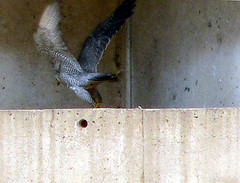
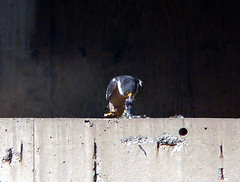
Max GroomingThings have been pretty much on task with our parents and chicks. Today, Saturday, I went up early and stayed about 5 hours. This weekend is book fair weekend, so it’s an exciting time for our neighborhood with lots of people coming down to buy books. I got a nice view of the early visitors to the fair, which was cool.

Anyway, there’s a lot of noise coming from the chicks in the nest now. I suppose we are getting close to actually getting to see them. I’m excited! I wonder how many there are.

Hercules and Max are busy parents, bringing lots of prey into the nest and dropping it off. Honestly, they aren’t staying very long at this point. When the chick(s) were younger, one of the parents would usually drop down into the nest and be in there with them for a bit. Now, they just come in, drop the food in and leave. Those kids are driving them crazy! Kidding.

The Wacker Chick Banding!

•May 31, 2006 • Comments Off on The Wacker Chick Banding!

Chicks in the Box!Not much to report on Max, Hercules and family. I saw them take two pigeons and some sort of shore bird into the nest between yesterday and today and was showered by a bunch of warbler feathers as Hercules plucked her prey on the Monadnock roof.

About two weeks ago, Mary Hennen asked me if I’d like to attend the banding of the Wacker chicks. YES!!! I think I showed a smidge more poise than that when I answered, but not a whole heck of a lot more. May 31st, 2006. Today. Chick banding!! I am a bit excited.

I watched the prison birds for a couple of hours and then headed over to the Wacker building at 10:30am for an 11am rendezvous with Team Wacker Banding. I stopped at the Sears Tower Starbucks and picked up an iced green tea, which I sipped while waiting in the Wacker building’s lobby for a half hour, trying not to look at my watch ever two minutes.

Business people in power suits streamed in and out and I started to feel very out of place. Them: fine tailored suits in grays and blacks, nice shoes, strict hair. Me: boots, jeans, a green t-shirt and festooned with a packed-to-the-gills camera and field bag, a spotting scope case, a large tripod and a small tripod.

Finally, a similarly dressed group came through the revolving door and I moved to greet them. Mary Hennen led the group. Matt from the Shedd Aquarium introduced himself first. He’s been on the project almost as long as Mary, nearly twenty years. Chris from the U.S. Fish and Wildlife service was excited to test his newly learned banding skills. Finally, John and Katrina from the Lincoln Park Zoo veterinary staff greeted me. What a nice group of people. Carrying boxes, ropes, veterinary supplies, buckets and various other tools, we all headed up to the building manager’s office.

Peregrine Falcon Female - RahnI’d been at the Wacker site before, so I knew exactly where we were going, up to the top, to one of the large a/c rooms. When we arrived, the team went into a well-rehearsed routine, setting up a table and equipment while Matt helped Mary get her harness and ropes on and secured the rope to a large piece of rebar.

Since the crew seemed to have everything under control, I went to the ledge door window. The female stood in a defiant pose right outside. She stared in the window, screeching angrily. Mary asked me to try to get a good picture of her leg bands, so I clicked pictures madly. I saw the bands clearly, though: Black “01” over Green “A”.

Rahn's LegbandsFinally, everything was ready. Mary put on her helmet, heavy leather gloves and thick over-shirt and we opened the door. Head down, box pushed before her, she crawled out onto the ledge.

The parents went absolutely nuts. Of course, all the chicks were at the northernmost corner of the ledge, requiring Mary to crawl to the other side of the building on the ledge. All the while, the male and female parents were diving down, screeching, and trying to drive her back. I heard several loud thunks as their knuckles hit her helmet, but Mary plowed on. She’s done this so many times, I don’t think she even noticed. Quickly, she packed the chicks into the box, turned and made her way back. We spotted for her, Matt yelling out “duck!” when one of the parents was about to hit. And then she was in!

Before the trap door shut, I looked out and noticed the windows of adjacent skyscrapers filled with people. It was sort of breathtaking.

Matt banding the first chickThe first chick banded was a male. Matt reached into the box and pulled the screeching little guy from the box. Expertly, he laid him on his back on the table and Chris (USFWS) placed a towel over the chicks head in order to calm him. Immediately, the screeching stopped and the chick stilled.

Mary handed Matt the first set of bands, B/G, E/23 and he quickly put it around the chick’s left leg and then put two rivets through the tab on the edge of the band. No part of the banding process pierces the chick at all. Then, he attached the pinkish-purple USFWS band to the right leg – #220649474.

Taking a blood sampleNext, Katrina and John, the Lincoln Park Zoo vet techs, went into action. They very expertly took blood from a major vein that runs under the wing. The chick didn’t even flinch. We can all only wish that most human phlebotomists were as gentle as John. The vial of blood was labeled and stored and will be used for genetics studies.

Dusting for LiceLastly, we dusted the chick for bird lice. John is doing a study involving bird lice and was hoping to get some samples. Although we dusted all four chicks and looked very hard, we didn’t get even one lice from this bunch. They were clean! Although, I have to admit that I helped look for lice and thoroughly enjoyed getting a great opportunity to scritch the bellies of all of the chicks. I doubt they enjoyed it as much as I did. Here is another picture of one of the males as we looked for lice on his back.

053106_wacker_mary_bandingMary banded the second male quickly, blood was taken and lice weren’t discovered. She used the time to give Chris a good lesson on banding. I jotted notes down too. Never know! This little male was B/G, E/24, #220672293. On to male number three!

Mary Gives a Banding LessonChris was going to go last in the banding, so the third male was pulled out of the box and Mary gave him a more detailed banding lesson. She was really fast. It was amazing. This male was B/G, E/25, #220672297.

Chris does his first banding!Finally, it was Chris’ turn. He pulled the largest chick, the only female, from the box and set her on the table. She was the biggest so the had the largest legs to grab, but I’m not sure Chris got the best deal as in my opinion, that female was the feistiest of all the chicks.

She screeched and flapped and bit and struggled the whole time. Chris did really, really well as he put her bands on: B/G, K/36, #168702025. Soon the angry female was back in her box.

Etienne giving us an earfullIt was all over too soon for me (but I’m sure not for the chicks). We opened the door to a very angry mother and father falcon and Mary put each chick back out on the ledge. Then, we shut the door quickly to allow the family a very, very noisy reunion.

The dad really gave us an earful while I snapped a couple of pictures while the mother flew around behind him. The chicks finally started to wander to their favorite places on the ledge, screeching the whole time.

So, everyone was home, no one the worse for the experience. We packed up, I bid goodbye to the team and went on to the museum.

I have a short video of the experience in my July 11th missive. Enjoy!

Taxonomy 101

•May 29, 2006 • Comments Off on Taxonomy 101

Hopping DownWhat gorgeous wings these guys have. An impressive span mixed with such a conglomeration of colors, really very stunning. If you click on the above picture, you can see the primary and secondary flight feathers I was yammering on about previously. The falcons primaries are huge!

I had much to do at work today, so I couldn’t stay long. I did not see Hercules, but Max was very actively tending to the chicks. He really didn’t stray very far away. I caught this picture as he was jumping down into the nest to a chorus of chick vocalizations. I couldn’t see for sure if he had anything in his talons, but it didn’t really appear that he did.

On Recognizing Peregrines – Since I brought up the beautiful wings, maybe I’ll talk about peregrine taxonomy and identification.

Peregrines are a type of raptor, which is a bird of prey that hunts for food using its sharp, hooked beak for tearing and strong, sharp talons for grasping. Raptors are known for their excellent vision. They are predatory and carnivorous (although vultures mostly eat carrion). The diet, habits and hunting styles vary greatly between species. Wing shape, body proportions and flight style also vary greatly.

On Taxonomy – Taxonomy means “the science of classification”. Biologists group and categorize extinct and living species of organism according to a number of different taxonomic schemes. Linnaeus, a Swedish botanist, physician and zoologist, invented the science of taxonomy when he published his book Systema Naturae in 1735. The full title of the book translates as: “System of nature through three kingdoms of nature, according to classes, orders, genera and species, with difference of character, synonyms, places.” His classification scheme, with additions and edits, is still used today.

The classification hierarcy looks like this: Kingdom –> Phylum (Division (for Botany)) –> Class –> Order –> Family –> Genus –> Species. Organisms are classified according to shared physical characteristics.

Like us, Homo sapiens sapiens, Peregrine Falcons belong to Kingdom: Animalia as we are both animals. We also share Phylum: Chordata, which means that we all have had, at one time in our development, a hollow dorsal nerve cord (notochord), pharyngeal slits (slits in the wall of the throat), an endostyle (a groove in the wall of the throat) and a tail.

From here, it gets complicated, with subphylums, infraphylums, superclasses, etc… But, in the simplified version, birds and humans part company at this point. We humans go off with Class: Mammalia (the mammals) and birds go into Class: Aves.

Two superorders separate birds that can’t fly, like ostriches and emus (Superorder: Paleognathae) from birds that can fly (Superorder: Neognathae). Obviously, peregrines can fly – and how! So, next they are split from birds in the infraclass: Galloanserae, which includes birds like ducks, geese and chicken-like birds (grouse, pheasant, quails, etc..) into the infraclass: Neoaves.

Now we get to orders. Some taxonomists put all diurnal birds of prey in the Order: Falconiformes. But, some taxonimists have split the order in two.

The taxonomic order Acciptriformes includes most diurnal (active in the day) raptors like hawks, eagles and vultures. But, falcons have thier own order called Falconiformes. Nocturnal (active at night) birds of prey are in the order Strigiformes, which are owls. The Sibley-Ahlquist taxonomy expanded this group to include nightjars.

The Acciptiformes include four families: Cathartidae, Pandionidae, Acciptridae and Sagittariidae. The Family Cathartidae includes the New World Vultures, which are vultures (including condors) found in North and South America. Osprey comprise the Family Pandionidae. The Secretary Birds comprise the Family Sagittariidae. But the larges family in Acciptiformes is Acciptridae.

Acciptridae includes accipiters (bird hawks), buteos (buzzard hawks), eagles, kites, bazas, buzzards, goshawks, sparrowhawks, snake-eagles, serpent-eagles, harriers and Old World vultures. So, that’s the big family.

The order Faloniformes includes all members of the Family Falconidae, the True Falcons, which means falcons, kestrels, merlins, gyrfalcon and the Crested Caracara, which is an uncommon bird that lives in Texas and Baja California.

On Anthropomorphizing

•May 28, 2006 • Comments Off on On Anthropomorphizing

Marital SpatMax and Hercules have a complicated relationship. I mean, what couple doesn’t, huh? But today, they seemed unusually tetchy with one another. The peevishness seemed to arise from some disagreement regarding who got to perch on the Monadnock ledge.

Hercules perched there as I arrived. About 12 minutes later, Max flew in from the east carrying a portion of pigeon. Hercules called to him as he passed, but didn’t move as he landed on the nest ledge and dropped in. He was inside for about 4 minutes.

When he came back out, he looked directly up at Hercules and let out a few piercing calls. She called back. He responded. Interesting. Finally, he took flight directly for her and landed on the ledge, approximately a foot from her.

“Awww,” I thought, free-form anthropomorphizing and looking forward to seeing some affectionate preening or some other such behavior.

Hercules flattened her body into a pecky torpedo and thrust her head at Max while stepping menacingly towards him. He screeched back at her, but held his ground.

“Hmmm,” I thought, romantic anthropomorphic daydreams waning.

As far as I could tell, they never touched, but they argued loudly over the space for the next few moments. Finally, Hercules took off and Max settled into her vacant spot.

I got the above picture about an hour later. Hercules came in from the southeast with an unknown bird in talon. As soon as she got to the nest ledge, Max dropped down from the Monadnock ledge and landed next to her. She dropped the prey, he took it and went into the nest, returning maybe a minute later and immediately taking off for the Monadnock ledge again. Hercules followed right behind him and contention for the ledge began anew.

I snapped this picture of Max defending his position fiercely. Eventually, though, Hercules won. Max left for the skyperch.

Never anthropomorphize.

But, since I brought it up, I guess I should discuss the issue a bit here.

Watching wildlife requires me to write down my observations in as cold and clinical a way possible. My field journal looks nothing like this journal, which I write for my own pleasure and to share with people who would be bored by the bare bones scientific observations.

I can’t really help anthropomorphizing a bit as I watch Herc and Max. But, I have to try to keep it to a minimum. Animals do not behave in the same way we do (duh). Assigning human motivations to the falcons can cause me to misrecord behaviors.

For instance. Look at the above anthropomorphized account. If I allowed it, my mind could imagine the squabble arising not from merely a territorial dispute but from an actual fight between the “husband” and “wife”. I might then go down causal avenues having more to do with how human mates relate to one another rather than how peregrine mates behave with one another.

I could start seeing little things. A bird left messily on the ledge. Max spending too much time with the chicks. You see where I’m going with this? Pretty soon, I have a whole story that has absolutely nothing to do with peregrines, basically wasting my observation day.

Okay, if we are so concerned with anthropomorphizing, why name them? Some people don’t. Mary and many others, however, realize that naming things is one way that humans use to relate to living things in their sphere.

And, let’s face it, falcons are really hard to relate to.

When we get a lunch break, we don’t run out the door, look for a cow and dive down on it at an alarming speed. We don’t then grab the stunned cow in our hands and hustle away to our lunch table to bite its head off before feasting on its innards. We go to McDonalds.

Most human mothers don’t stand a ways off while their babies take their first step … off a 40 floor ledge.

The falcons do some things better (in my mind) and humans do … other things. Anyway, the point is, falcons and humans are very different.

But, the hundreds of people in buildings around these peregrine nests who watch them every day need some way to relate to these majestic birds. One way to relate is naming.

Mary gets name suggestions from interested parties or gives the right to name the chicks to people who have been instrumental in helping us for the season. Sometimes, she and the banders simply like a name and give it to the chick in question.

The names help everyone to feel closer to the falcons. It’s just how we humans are, I guess. And feeling closer translates into watching more carefully. Downed chicks are protected more readily. Injuries are reported.

The end result? Everybody and everyfalcon wins.

On Storing Specimens

•May 27, 2006 • Comments Off on On Storing Specimens

Ready for Take-offAhhhh, Saturday. I tried for a picture of Max’s leg bands, but just could not get one that was clear enough. The picture above, at the very least, shows evidence of black over green. I am fairly sure of the “5” on the top. That bottom letter is still killing me, though. It looks, for all the world, like a tipped over “E,” but that just can’t be. So, I keep trying.

Herc and Max spent most of the time I stood on the garage perched on the skyperch, the Old Colony building or the Monadnock. A lazy Saturday for all, I guess.

I heard some screeching from inside the nest and saw a puff of feathers come out that would indicate baby or babies trying their wings. I am guessing that the babies will be out on the ledge sometime late next week, possibly Thursday to Saturday. I’m pretty excited. How many could there be? No idea. My guess is 2 to 3.

This makes sense in the development stage too. From what I’ve been reading, by day 22, the flight feathers really hit some big development and the chick’s legs are nearly fully grown. This is right at the age when banding is safe, since the legs won’t experience any more growth, so the bands will fit correctly. The babies are very active at this point and may even begin flapping their wings in order to strengthen them.

The feathers of the wings and tail really control a bird’s flight, so they are important. I’ve already put three new words into your vocabulary, I hope. Countour feathers are the feathers distributed over the whole body. Some of these contour feathers modify to form the remiges (flight feathers of the wing) and rectrices (flight feathers of the tail).

If you stretch a birds wing out, you will notice that the rear edge is lined with big feathers. These are the flight feathers. The primary flight feathers are on the outside, farthest away from the body and are connected to the bird’s hand bones. These are the largest of the remiges and the main feathers used for flight – they propel the bird through the air. When a bird lives indoors as a pet, owners clip these feathers (it’s painless) so that the bird cannot fly around the house where it may injure itself. So, lesson is, without the primaries, the bird can’t fly. The secondaries are the next feathers in and are connected to the birds arm bones. They help give lift, sustaining the bird in flight.

The tail feathers (rectrices) are used for steering and balance. They are used like a rudder and also like a brake. With the speed and agility of the peregrine, they certainly need these!

At any rate, our chicks should have both rectrices and remiges emerging from their shafts and growing at a good clip. The secondaries grow more quickly. I suppose that is so the bird doesn’t try to fly before it is ready. You can see a picture of this stage here.

Peregrine Falcon Prey Remains 1I found a Cedar Waxwing on the garage top. It was very fresh. If this were a weekday, I would baggie the remains and take it into the museum. But, it wasn’t, so I’d have to store it until Monday. With nowhere to store it, I took several pictures instead: from the back and from the front.

Actually, this might be a good time to mention the woes of marriage to a biologist type, which I am. My husband, Sean, is a wonderfully intellectual man with interests in many, many things. Not only has he been been fantastic with regards to my excited going on and on and on about the prison falcons and falcons in general, but he’s actually come up to watch with me now and again. He works as a computer network engineer at Midway Games.

Peregrine Falcon Prey Remains 2One thing that he has asked me not to do is bring home animal remains and store them in our refrigerator. For most biology types, popping this sort of thing into the fridge until you can take it into the museum isn’t a problem. We double baggie this stuff and, if Ziploc commercials are to be believed, what is inside, stays inside and doesn’t contaminate outside, so no prob if a half bird is stored next to your Yoplait, right?

But, most people, I suppose, don’t feel this way. So, in honor of Sean’s sensibilities, I had promised to buy a small cooler to store anything of that sort out of his sight. I had not yet done so, so couldn’t bring this Cedar Waxwing home.

While I don’t find the following anecdote particularly gruesome, some might, so stop reading now if you are a sensitive type.

When I was in Oregon, working on my first degree in biology, I roomed one summer with two people in my class who were working for the US Forest Service during break.

One day, as they were coming down out of the mountains, they saw a dead doe on the side of the highway and stopped to make sure she was dead and not in need of help. She was, but she was pregnant. So, they did what they could, hoping they might be able to save the fawn.

The fawn, however, was going to be stillborn anyway as it had a remarkable birth defect – it had two full heads. Of course, they brought it home for our biology department’s museum collection. This, however, was a Friday night. So, we cleared out the bottom of the fridge and stored the rather large specimen over the weekend.

I guess that’s where I learned to be a bit blase about the whole thing. Not everyone, including my husband, feels this way, of course. That two-headed fawn still resides, as far as I know, in the Southern Oregon University Natural History collection. ‘Nuff said.

The “Snatch and Grab” Collection Technique

•May 26, 2006 • Comments Off on The “Snatch and Grab” Collection Technique

Herc on the Monadnock LedgeToday was more of the same for our pair. In the hour and a half that I was there this morning, they brought a pigeon and, apparently, a blue jay to the nest. Hercules caught the blue jay and took it to the Monadnock roof to eat a bit before taking the rest to the babies.

I call this technique of prey identification “The Snatch and Grab”. Hercules began her insane speed-plucking routine on the Monadnock and I walked over to stand on the garage roof corner beneath her. The wind blew in nicely from the west causing the feathers to rain down on me. I snatched them from the air as they did and stuffed them into a baggie. Later, John and Dave identified the feathers as Blue Jay.

Hercules Hunting from the Monadnock LedgeWhile this technique doesn’t allow me to take actual bird heads, wings, bodies, etc… in for identification, the brilliant staff in the bird division usually has no trouble identifying a bird from one, solitary feather. Amazing.

Now, that I am becoming familiar with the species these falcons seem to bring in with regularity, I, too, can make some good guesses from feathers. But, I’m nowhere near, nor probably ever will be, the skill level of Dave Willard, Mary Hennen, John Bates, et al. It’s really, really fun to learn, though, and I’m better than I was a month ago.

Leg Band Identification Error

•May 25, 2006 • Comments Off on Leg Band Identification Error

Hercules' LegbandsWell, it sucks when you make a mistake. But, when you make a mistake and keep making it? Right now, I feel brain damaged.

I’ve continued to take pictures of the MCC female, even though I’ve seen her leg band time and again. I need a good, clear picture of her leg bands so that I have photographic proof of my identification.

This morning, I worked diligently to photoshop today’s pictures of Hercules standing on the nest ledge. I hoped to get a good leg band picture and, happily, I did. Grainy as it was, I could read it. I blinked. And I blinked. I flipped the pages of my “Write-in-Rain” field journal, noting weeks and weeks of, “Confirmed yet again. Female = r/b, W/*D,” in entry after entry.

I looked back at the photo which quite clearly showed a black band over a red band with a tipped over D (*D) on the top black band and a W on the bottom red band. In fact, if you, yourself, click on the above picture, you will see the same thing.

After inverting it the first time, I guess my brain just decided to keep on doing so. I assume just to Keep Life Simple. I think my brain goes rogue from time to time.

According to the database, b/r, *D/W (geez, I /still/ have trouble typing that) is the leg band of a bird named Hercules.

I’ve gone back and edited out the many AKAs of Hercules, just so readers won’t become confused. I’d started calling her Madeline early on, after the little girl of the Madeline books. I got her leg band information days after I started watching, inverted that information and started referring to her by her “real” name, Bern. But, her real, real name is Hercules.

Personally, Hercules isn’t my favorite, but I bet there is some sort of funny anecdote to go with why she was given that name.

So, this stands as a nice example of why one records the same stuff over and over again while watching an animal in the field. Also, one should try to record that information in a number of different ways, even if it seems tedious. Mistakes happen and you just hope you have enough checks and balances in place that you’ll catch it. Eventually.

A Half Bat

•May 24, 2006 • Comments Off on A Half Bat

Today it was pretty windy and stormy, so I didn’t take my camera out. Hercules came in with a Yellow-Billed Cuckoo, handed it off to Max, who took it into the nest. Hercules visited the niches one and three to the left of the nest and and did her vocalize, peer-down, hop in, hop out routine.

Herc kind of surprised me by flying straight for me at one point. She ended up landing on the stairwell roof, corner closest to me, so about 5 feet over my head. Flying in, it seriously looked like she was going to land right on the railing in front of me. I would have loved to snap that picture, but alas.

After about 15 minutes, she took off for the sky perch, but was only up there for a few minutes before she spied something she wanted.

A very, very narrow alleyway runs between the garage and the two buildings to the west (one is the building that houses the sky perch). Because the buildings on both sides are tall, the space is very dark most of the time. So, when Herc dove and went into the alley, I couldn’t make out what she chased through the murk. It flashed white briefly and seemed pigeon sized.

Peregrine Prey Scraps - Baby StarlingShe missed on the stoop and proceeded to try to chase it down. I’d never seen this happen before, but Max joined the chase. A fast, insane flight back and forth through the alleyway commenced, but the two falcons came away empty-taloned. Max flew back to the nest ledge, with Hercules following about 10-feet behind.

Suddenly, I saw a little brown puff falling down towards her. She snatched it up and landed on a fire escape nearby to eat. I pondered the falling bird. Hmmm.

It started to rain, so I packed up. After walking the jail perimeter and garage block, I decided to go down the dark narrow alleyway. About halfway down, three delivery trucks almost completely blocked the alleyway. I squeezed by them. When I got to the other side, approximately under where Hercules had been eating, I looked up.

Peregrine Prey Scraps - Half BatAbove me zig-zagged a snag of fifteen floors worth of metal fire escape. On the 1st floor fire escape platform lay two sets of remains. I could not walk up there since the fire escape was rolled up, so I used my tripod to reach up and poke the bodies down. After they fell, I crouched and bagged the two bodies up – a bird and a bat!

“Wow!” I said, straightening and looking at the baggies. Hearing a noise behind me, I turned. Three delivery men stood in a dock behind me just staring at me, jaws dropped. I smiled and waved cheerily, turned and walked out of the alleyway onto LaSalle.

I can’t imagine what they thought I was doing collecting dead things in a very dark and narrow alleyway during morning rush. Kind of makes me laugh to consider.

The brown puff was a baby starling. It obviously fell out/off of something since it was dropping not flying when I saw it. I guess it was the right place at the right time for Hercules. Literally, prey falling out of the sky. The other body was a half-bat! Cool find.

Chick Development update – The chicks should now be able half the size of their parents. They still are puffy with baby down, but the contour feathers should be visible on the margins of the wings and tail. A small bear patch behind the eyes develops and may even show signs of contour feather growth. You can see a picture of this stage here.

Max Eats a Sizable Pigeon

•May 23, 2006 • Comments Off on Max Eats a Sizable Pigeon

Mmmm!Max caught a pretty sizable pigeon this morning and ate half of it with great gusto before taking the other half into the nest. I got a couple of looks at his leg band, but just could not make that bottom letter out. It looks something like a tipped over E, but when Mary and I looked up b/g, 5/*E in the falcon database, that number came back as a female. Hmmm. Well, I’ll keep trying. I did verify that the top number is a ‘5’.

All seemed normal with the pair. While I was there, they got a pigeon, a starling, a warbler and some sort of dark brown bird (half bird). They were really packing a lot of food into the nest. The babies must be getting pretty big!

The Waukegan Webcam

•May 22, 2006 • Comments Off on The Waukegan Webcam

Again, no pictures of note today of the MCC birds. Hercules caught a pigeon and a warbler while I was there. Same routine. She brings it in, Max comes down from skyperch, much vocalization ensues, Max takes the prey into the nest, Hercules flies off to get more. Max reemerges and heads back to the skyperch to wait.

Waukeegan Webcam Capture 1When I got into work, I fired up the Waukegan webcam. Waukegan sits on the shore of Lake Michigan, about ten miles south of the border with Wisconsin and forty miles north of Chicago. I’ve never been to Waukegan but I have ridden the Metra Northline a grand number or times, especially when Jay, Kay and Hill lived in Evanston years ago.

For some reason, the train conductors loved saying the word “Waukegan” and would walk down the aisle before the train left, shouting, “This train makes all stops north and ends at WAHW-KEEEE-GAN. WAHW-KEEE-GAN!”

I guess it is sort of a funny word.

Waukeegan Webcam Capture 2It looks as thought the Waukegan falcons have four chicks. These guys, you might note, are a lot bigger than the Evanston chicks. They hatched about a week or two before them.

The MCC chicks probably look about like this, as they are circa 17 days old now. The parents no longer overwhelm our chicks in size by day 17. The feathers that cover the body of the bird, called Contour Feathers, start to push the first baby down out. I guess it’d sorta be like human teething. The tips of the tail feathers should be visible at this point. You can see this stage here.